
Blog Details
Discover excellence in thoracic care with Dr. Balasubramoniam
KR
Focused treatments, cutting-edge technology, and compassionate care
tailored for your health journey.
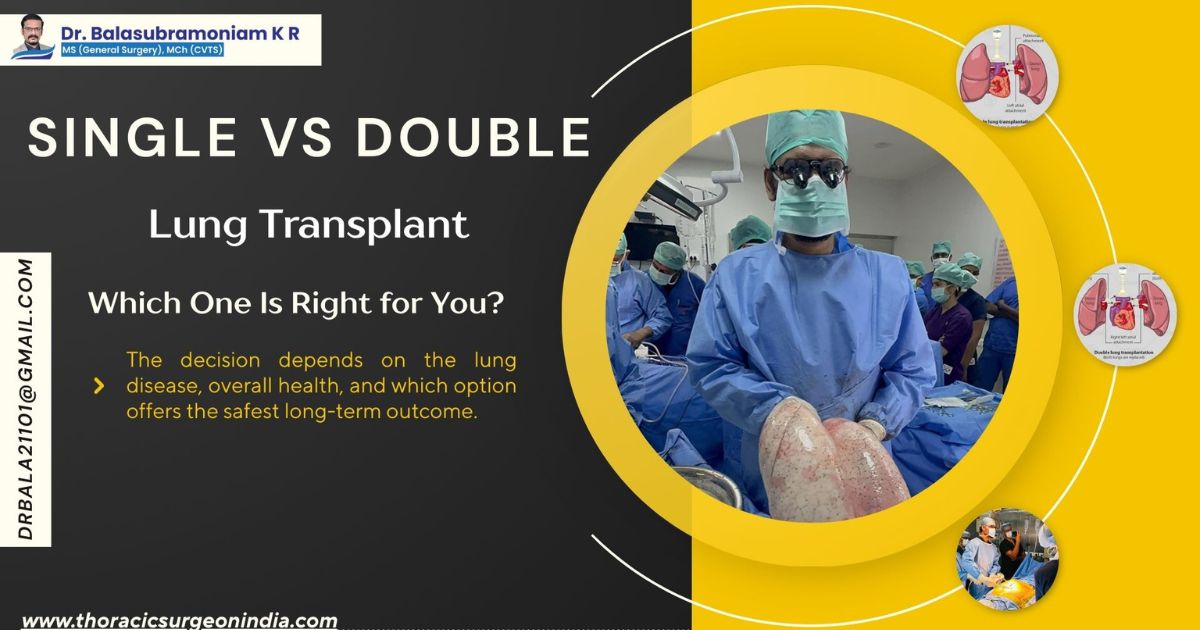
Single vs Double Lung Transplant: Which One Is Right for You?
Single vs Double Lung Transplant: Which One Is Right for You?
One of the most common questions patients ask me during transplant evaluation is, “Doctor, will I need one long or both?” This question lies at the heart of Single vs Double Lung Transplant: Which One is Right for You? And often comes with understandable anxiety. Patients worry about the complexity of surgery, recovery time, and long-term outcomes.
My role is to help them understand that there is no one-size-fits-all answer. The decision between a single lung transplant and a double lung transplant is guided by the nature of the lung disease, the patient’s overall health, and which option offers the safest and most meaningful long-term benefit
What Is a Single Lung Transplant?
In a single lung transplant, one diseased lung is replaced, while the other lung remains. This approach is commonly considered when one lung is more affected than the other or when replacing both lungs is not medically necessary.
When I consider a single lung transplant:
- Certain types of pulmonary fibrosis
- Selected cases of COPD
- Older patients where shorter surgery time is safer
- When overall disease is not equally severe in both lungs
A single lung transplant usually involves shorter surgery time and may be appropriate when risks need to be minimized.
What Is a Double Lung Transplant?
A double lung transplant involves replacing both lungs. This is often necessary when disease affects both lungs extensively or when leaving one diseased lung behind could cause complications.
I usually recommend double lung transplant for:
- Advanced COPD with severe infection risk
- Cystic fibrosis
- Pulmonary arterial hypertension
- Severe post-COVID lung damage
- Diseases affecting both lungs equally
Although it is a more complex surgery, replacing both lungs often offers better long-term lung function in the right patients.
How I Decide Between Single and Double Lung Transplant
This decision is never based on preference alone. I look carefully at:
- Extent of lung damage in each lung
- Risk of infection from the remaining lung
- Heart function and blood pressure in lungs
- Patient’s age and physical strength
- Expected long-term quality of life
Sometimes patients assume that replacing both lungs is always better. That is not true. The right surgery is the one that offers the safest recovery and best outcome, not the biggest procedure.
Recovery Differences Patients Should Understand
Recovery varies from patient to patient, but there are some general differences:
- Single lung transplant may involve slightly faster early recovery
- Double lung transplant often requires longer ICU and rehabilitation time
- Long-term breathing capacity may be more balanced after double transplant
- Medication and follow-up are lifelong in both cases
What matters most is not speed, but stability and long-term lung health.
Common Misunderstandings I Often Clarify
Many patients believe:
- “Double lung transplant means double risk”
- “Single lung transplant is always easier”
In reality, the risk depends on matching the surgery to the disease. A single lung transplant done for the wrong condition can cause more problems than a double lung transplant done at the right time.
Single vs Double Lung Transplant: A Simple Comparison
|
Point |
Single Lung Transplant |
Double Lung Transplant |
Robotic Surgery |
|
Lungs Replaced |
One lung |
Both lungs |
Very small cuts |
|
Surgery Duration |
Shorter |
Longer |
Minimal |
|
Disease Coverage |
Limited to one lung |
Treats both lungs |
Very little |
|
Infection Risk |
Higher if other lung is diseased |
Lower long-term risk |
Very short |
|
Long-Term Balance |
May be uneven |
More balanced breathing |
Fastest |
My Advice to Patients and Families
Choosing between a single and double lung transplant is not a decision patients should make alone. It requires careful evaluation, honest discussion, and realistic expectations.
In advanced transplant programs, including those in Hyderabad, this decision is made by a multidisciplinary team with the patient’s safety and future in mind.
In Simple Words
Some patients need one lung replaced, others need both. The right choice depends on how severe and widespread the lung disease is and which option offers the safest, longest-lasting improvement in breathing and quality of life.
FAQ Section
1. What is the difference between single and double lung transplant?
A single lung transplant replaces one diseased lung, while a double lung transplant replaces both. The choice depends on how widespread the lung disease is and which option offers better long-term safety.
2. Is a double lung transplant always better than a single lung transplant?
No. More surgery is not always better. I recommend the option that best matches the disease pattern and offers safer recovery and long-term benefit.
3. Which lung diseases usually need a double lung transplant?
Conditions like cystic fibrosis, pulmonary arterial hypertension, severe COPD, and extensive post-COVID lung damage often require replacement of both lungs.
4. Does recovery differ between single and double lung transplant?
Early recovery may be slightly faster after a single lung transplant, but long-term care, medications, and follow-up are lifelong in both cases.
5. How do doctors decide which transplant is right for a patient?
We assess lung damage, infection risk, heart function, physical strength, and expected quality of life before recommending the safest option.
6. Where are advanced lung transplant decisions made in India?
In cities like Hyderabad, multidisciplinary transplant teams evaluate patients carefully before deciding on single or double lung transplant surgery.